IRS Bumps Up Mileage Rates for the Second Half of 2026
Big news everyone. The IRS has blessed us with a mileage rate increase. Hold your applause.
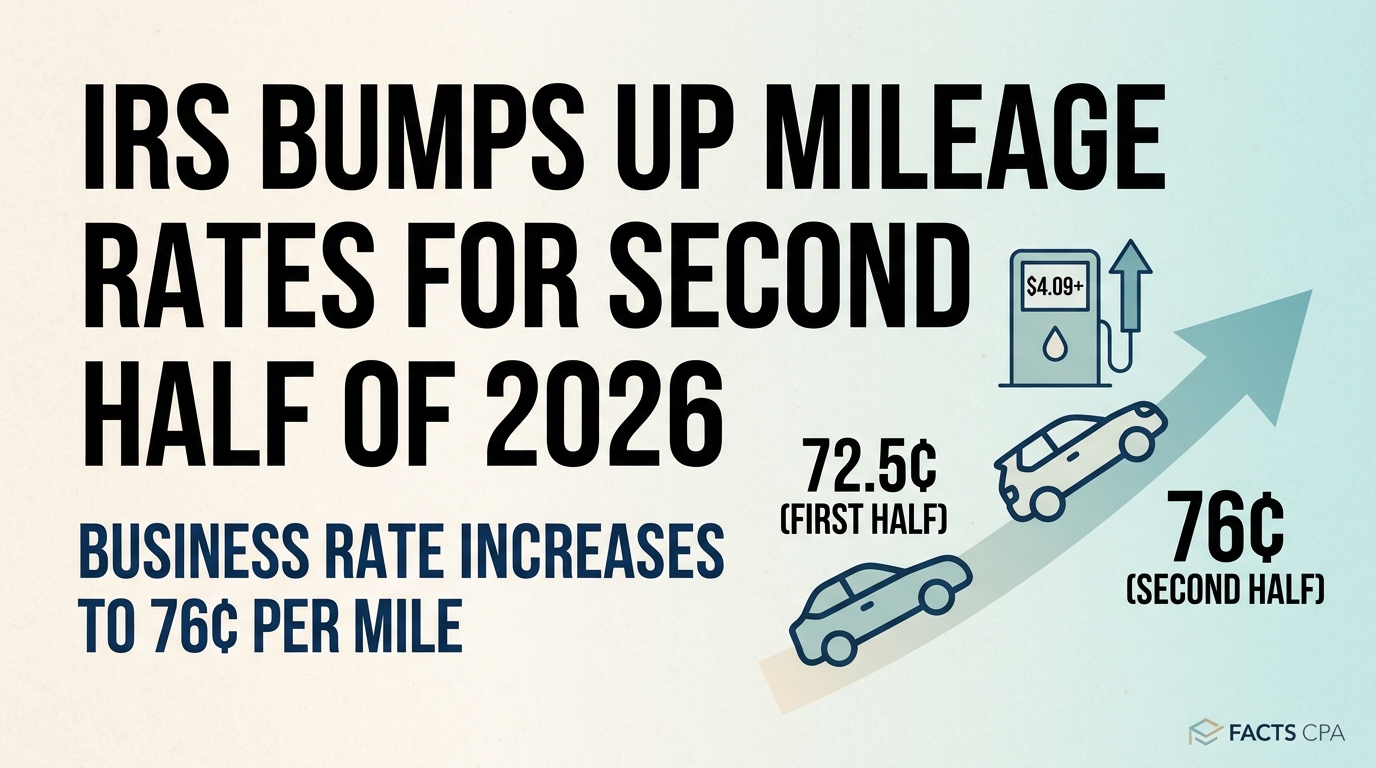
Starting July 1, 2026, the business mileage rate went up from 72.5 cents to 76 cents per mile. That’s 3.5 cents more per mile. At that rate, if you drive 1,000 miles for business in the second half of the year, you’ll pocket an extra $35. Don’t spend it all in one place.
But here’s the thing. We did the math, and the IRS actually got this one right.
Gas prices have jumped from around $3.20 per gallon in early 2025 to $4.09 per gallon right now. That’s roughly a 28% increase at the pump. Sounds brutal. But let’s break it down per mile.
Assuming an average car gets about 25 miles per gallon:
Early 2025: $3.20 per gallon ÷ 25 mpg = about 12.8 cents per mile for fuel
July 2026: $4.09 per gallon ÷ 25 mpg = about 16.4 cents per mile for fuel
That’s an increase of about 3.6 cents per mile in fuel costs.
The IRS mileage rate went from 70 cents in 2025 to 76 cents now. That’s a 6 cent per mile increase. So the IRS actually more than covered the fuel cost jump. And remember, the standard mileage rate isn’t just for gas. It also accounts for depreciation, insurance, maintenance, and other vehicle costs. The depreciation portion alone is 35 cents per mile.
So while it’s fun to complain about the IRS, credit where credit is due. They did their homework on this one.
The IRS issued Announcement 2026-11 in response to rising fuel costs, revising the rates that were set earlier this year in Notice 2026-10. Here’s the breakdown:
Business Use: 76 cents per mile (up from 72.5 cents in the first half of 2026, and 70 cents in 2025)
Medical or Moving Purposes: 23.5 cents per mile (up from 20.5 cents in the first half of 2026)
Charitable Purposes: 14 cents per mile (unchanged, because apparently charity runs on goodwill, not gasoline)
Depreciation Component: For business use, the portion of the mileage rate treated as depreciation remains at 35 cents per mile.
For context on why this happened mid-year: gas prices peaked at $4.48 per gallon back in May thanks to Middle East tensions and supply disruptions pushing crude oil into the $90-per-barrel range. The West Coast is still seeing prices over $5.59 per gallon, and states like New Mexico and New York have seen jumps of 27% to 34% year over year. The IRS doesn’t usually adjust rates mid-year, but when fuel prices move this much, they make exceptions.
What This Means for You
We’re already in the second half of 2026, so this rate applies now. If you’ve been tracking mileage this month, make sure you’re using 76 cents for any business miles driven on or after July 1. Miles from the first half of the year still get the 72.5 cent rate.
If you use accounting software or a mileage tracking app, double check that it’s updated. And if you reimburse employees for business mileage, make sure your reimbursement policy reflects the new rate.
The Takeaway
The math checks out. The IRS increase actually covers the rise in fuel costs and then some. Track your miles, use the right rate for the right period, and take the deduction you’re entitled to.
Questions about mileage deductions or how to track them properly? Contact FACTS CPA.